westhope logo

History of Westhope Craft College

The Long Room - The Garden - Start of College
Growth - Tuesdays - C&G


The College was founded by Anne Dyer and Elizabeth Rumble. Anne’s great grandfather, Henry Clement Swinnerton Dyer, a successful Manchester businessman, inherited this valley from the senior line of the family which had died out. The land that now forms the College garden, wood and paddock was originally two fields with a tree lined stream running between.

He started to build two farm cottages in one corner, facing two existing cottages. But before they were finished, he died, and his family decided to move down here. They took over the unfinished cottages, knocked then into one and made part of the field into a garden.

Anne’s grandfather, Leonard Swinnerton Dyer, built Westhope Manor. His sister Evelyn Martin had been married to an elderly friend of her father, but the marriage barely survived the honeymoon up the Amazon. He returned to India and she took over the cottage, extending it to her taste. There is an idealized portrait of her in the Library. She was reputed to be short. fat and fierce. When Evelyn bought the first car in South Shropshire, she found the old road too rough and steep for cars, where it rose up the side of the valley to Hillend, so she commanded the Council to build a new road from the white bridge to the turn before the manor, and they obeyed.

Everyone who has lived here has made alterations. Evelyn built the conservatory standing where the Harlequin and Peacock rooms now are. It was carpeted and used as a sitting room. Anne’s mother, Barbara, planted a fig tree in it which fruited for well over 50 years.


Top of page


The terrace originally only ran as far as the garden porch (the door at the bottom of the main stairs) and continued as a small earth bank. In 1911, the porch was pulled down and the Longroom, a temporary building designed to last 25 years, was added. It has more than outlasted its ‘sell-by’ date, but proved well insulated. Although it has a sprung floor for a ballroom, it was used as a sitting room.
It was the size of this room that made the idea of the college possible.

For a time, the Longroom was used as an unofficial village hall, for everything from money raising concerts, and marriage guidance, to meetings of local committees on rural transport.

Barbara Dyer always held that the house liked people and needed at least
two big parties a year to keep it happy!


Top of page


THE GARDEN

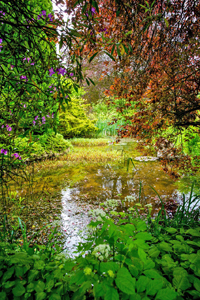
Evelyn was a keen gardener and laid out formal rose beds and a pergola in 1901, where the big lawn is now. There used to be seven gardeners in those days. The original garden ended just beyond the lower stream with a small shrubbery. But she was a fan of Gertrude Jekyll,
and wanting to build a wild garden, she took on the rest of the field.

Anne’s parents added to and altered the garden. There was always a running battle between her father who liked to plant shrubs, preferably prickly, in the flowerbeds and her mother, who didn’t
like weeding through the prickles.

During the second world war, the lawns were turned in to hay fields. In a good year, we could get
60 bales of hay off them. After the war, the ponies grazed it as well.

After Leonard Dyer’s severe heart attack in 1976, he was taken off all strenuous activity like opening the post and carving the meat. Instead, he dug the big pond at the bottom of the lawn. This was the culmination of his draining plans which scattered the wood with small ponds.

Living in a house with a garden laid out by keen gardeners means that all south facing walls are likely to be covered with shrubs. A magnolia was planted in front of the Thicket window by Anne’s mother in 1932. By the 60’s it covered the Thicket and Dormer Room window above. It was looking very sickly in 1990 when Anne’s mother died, and it was cut down but, In a year, it had sprouted again and is now growing happily.

In more recent years, sculptures have made an appearance in the garden, several by students
as part of their design course and a scent garden has been created within the walled garden.

1992 saw a burst of seat building around the garden and on the terrace. We have to pump out the pond at intervals, because of the soil erosion from the farm above. The tractor and tanker make a dreadful mess, so a concrete road was built, tastefully disguised with more seats.


Top of page


STARTING WESTHOPE COLLEGE

Ten years after Leonard’s death, Barbara decided that the College needed to start soon, if Anne and Elizabeth were not to be too old to do it! She built the Dower House ( Garden Cottage) while we did the alterations here. We ran three trial courses in 1978, to see if the idea worked. It did, so the building work began. Floors were pulled up and holes cut in walls, while all the furniture and craft materials were moved back and forth out of people’s way. The dogs did not approve at all.

When the College started, Anne’s mother gave us the house, but not one inch of the garden,
her great love. So in theory we were trespassing as we went out of the front or back doors and had
to pass on to her any plants we were given to plant where she wanted them. But she loved to see students walking round the garden through the long windows of the Dower House.

We furnished the College with a mixture of old family stuff and work by living craftsmen.Barbara said that everything she left in the house after Easter of 1981 was ours. But like Mrs Samuel Taylor, she was often seen, small and scurrying leaving the college with something under her arm that ‘she hadn’t meant to leave’. Once it was a lovely china bowl that just happened to be full of trifle at the time. She kept a very close eye on us, knocking on the window if students were still working after midnight, to remind them to turn the lights out when they went to bed.

Top of page


Elizabeth decided that we needed an area designed for the ‘mucky’ crafts and delicate negotiations were started with Barbara for space to build. The obvious place was exactly where she had
persuaded the Planning Officer would be vandalism when she wanted to build the Dower House in 1979.

The conservatory grew old. The great beam holding it to the house sagged and rotted. Although we had it repaired, the strain had damaged the rest of the structure. The great gales of the late 1980’s took their toll and finally in 1990, the last gale threw a chunk of roof through it.
Being north-facing, it wasn’t a great deal of good as a greenhouse, so we decided to replace it with three much needed rooms.

In May 1991, work started. By June we had a JCB on the site . Clearing the site revealed a great domed brick tunnel, possibly to do with the central heating stove that lived in a dungeon in the back yard. The cast iron heating pipes were found at various places, confirming Anne’s belief that the pipes went twice round the garden before entering the house.

Anne could never resist buying threads and fabrics and all sorts of people unloaded their attics onto the College. So, as the growing number of students needed more space, so did the amount of equipment and books.

As our numbers grew, the old car park at the Sawmills became far too small. We took a piece of the field opposite and built a new one. We meant it to be 16 metres wide but the Law Brothers obviously can’t measure and it ended up 24 metres wide.

Top of page


The Tuesday class started as a handful of people, but by 1995 we were struggling for space. The Longroom’s polished floor was suffering from dye and wet basketry materials and the weather did not always allow for working outside. Finishing the Rumble Room coincided with the craze for painting on silk, and almost at once, we were short of space again.
As we got busier on a Tuesday, more teachers joined us.

By 1995 we had four classrooms and a record number of 70 students on a Tuesday. The Westhope Commandments were invented by some of the Tuesday class, edited and converted by Mary Cartwright and worked by most of our regulars. John Hunt, recovering from a stroke and coming here under doctor’s orders wove the braid, set under the edge to disguise its unevenness.

Top of page


CITY & GUILDS

In 1983 we started the Embroidery City & Guilds with 4 students at one end of the Tuesday classroom. Gradually the class grew and the C&G class was moved to Wednesdays. It soon outgrew that.

Once a year we have our City & Guilds assessment and Exhibition. This causes a forcible tidying of the classrooms every year, after which it takes 6 months to find things again.

When we started design exam classes on alternate Mondays, we feared it was the thin end of the wedge. With trepidation, we asked the staff if they could manage one Monday a month, but there were so many students, it had to split into two classes.

Top of page


More: Newsletter: Contact us:
Subscribe to our Newsletter
Enter your email address below

Online:
Westhope College is a member of ARCA, the Adult Residential Colleges Association. Westhope College is an adult education craft college run by the Westhope Charity, a charitable company limited by guarantee. Registered number 2911113 (England & Wales) Charity number 1036877. Registered office: Westhope College, Craven Arms, Shropshire, SY7 9JL.
© Copyright 2012 Westhope Craft College - Terms & Conditions